Do you want a breast check
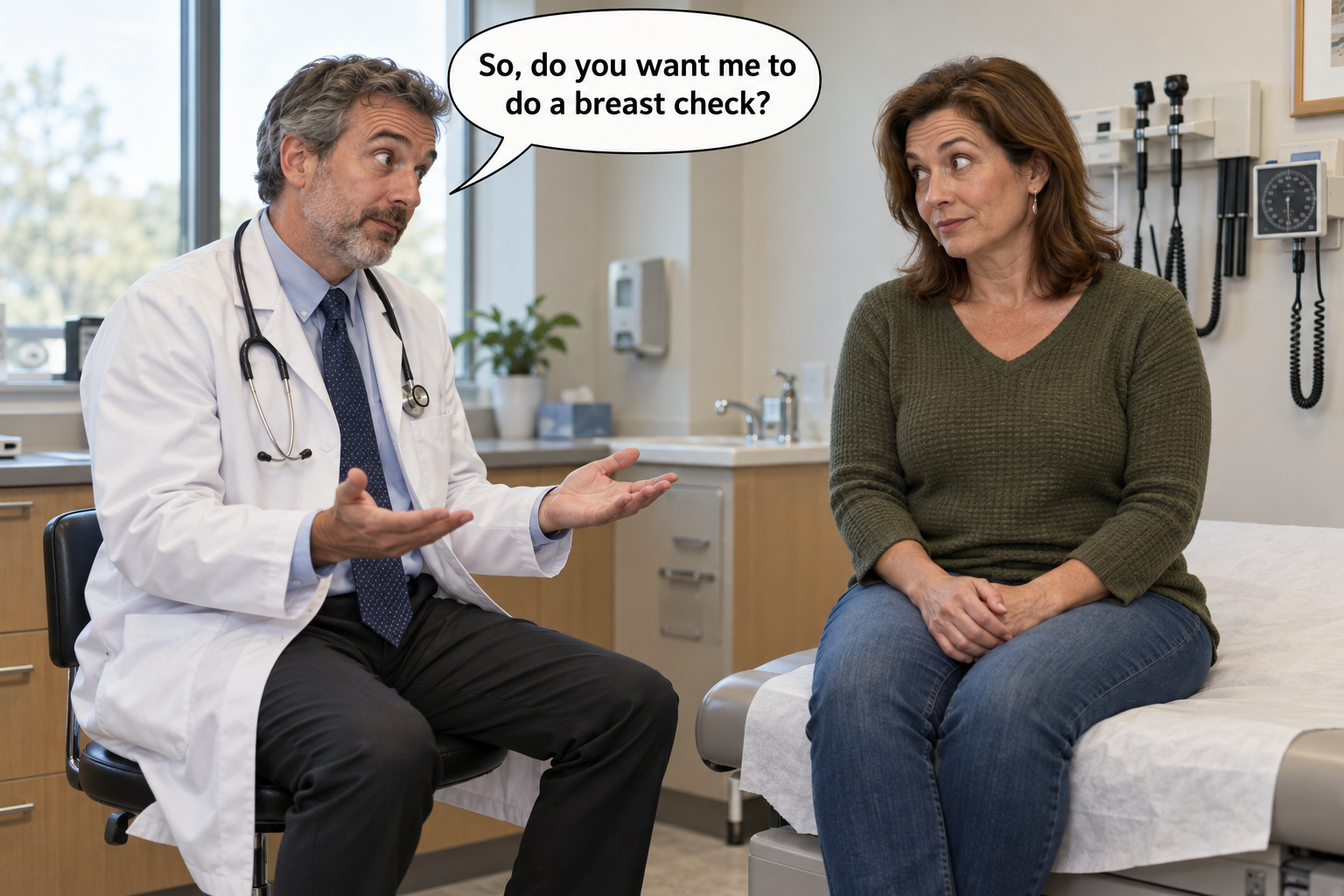
Do you want me to do a breast check?
That is what a patient was recently asked by her provider when she went in for a routine physical. This was not just for a checkup for a cough a cold but rather for a complete physical examination.
So how should that be answered?
“Oh yes please—I can’t wait.” Or rather isn’t that what you are supposed to do if I’m here for a physical? Of course, her real response was a polite ‘yes’.
So as a provider, should we ask our patients if they want us to listen to their chest or check their neck? Of course not. We must always perform what we believe is necessary. If our patient is there for a physical, that means we must look and examine everything, and thoroughly. That is implicit in why our patient is there. They have come in so that we can help them—or in the case of a routine physical, for us to make sure nothing is wrong. You cannot know if something is wrong unless you check. Breast cancer, a hernia, enlarged lymph nodes, a rectal cancer. These will not show up on a blood test, early on, which of course is when we can help the most. So, it is up to us, the provider to do what is necessary, not the minimum you get get away with. After all it is the health of your patient that is at stake. And if we don’t care about that, perhaps we should step aside and let someone who does take care of patients.
Certainly, if a patient is there for a specific complaint, then that is the exception. If I have an earache, look in my ear; a breast exam will likely not help me.
No one wants to be poked or prodded, especially in our “private” areas. But then, most of us don’t want to go to the doctor in the first place. Patients understand that a routine physical exam is important. But it’s not any good if it is not done or done well. We cannot wait for the patient to complain of a problem. It is our job to find the problem, before it really becomes one.
If a provider asks you whether you want a specific exam, it is always a red flag. They are asking hoping you will say no. They either don’t want to do it, or don’t feel comfortable doing it (far more common than you might think). Either way, you shouldn’t have them do it—because they likely will not know what they are doing. Now that’s a sad comment. But like everything in medicine, and in all fields, you have to do enough to be and remain competent.
I will read on a patient’s physical: “Rectal deferred.” Really? I have never had a patient ask for their rectal exam to be deferred. What does that even mean? Do they want to come back next week for it? No. It means that the provider does not want to do it.
So why examine anyone?
We are now told: get them in, get them out, order a bunch of tests, and maybe you’ll find the answer. But that was not the way we were taught—when we were told that about 80% of diagnostic dilemmas can be solved with a good history, about 15% by a thorough physical, and only a paltry 5% by expensive and frequently completely unnecessary tests. That teaching now appears to have been completely overlooked, as providers spend little time listening and examining and instead revert to ordering expensive tests that often miss the problem entirely. I cannot believe (actually, now I can) how many patients have been sent to me after an expensive scan revealed a hernia that could easily have been found on an exam.
If the provider does not perform a proper examination, then why go to see them at all? Just put your symptoms into AI and it will order the CT. And we wonder where medicine is headed.
Let’s take our heads out of the sand and do what we were all trained to do.
Listen, examine, then treat.