BLOG

BLOG

This BLOG, is a collection of thoughts and events, that continue the thread begun in my books. 

AI on the Horizon

I recently heard a story about a patient that was trying to get a hold of their PCP via ‘my chart’. They were informed that because the provider was too busy, they were unable to respond. Instead, the patient was instructed to go to ChatGPT, and input their symptoms. This, at first seems crazy, impossible, shocking and of course, shocking it is. Sadly I did not find it that surprising.

So, lets dive in a little deeper.

 First, that any provider would actually say such a thing is indeed shocking and I believe inappropriate. It is their job to answer such messages, whether they like it or not. And if they don’t like it, perhaps they should consider an alternative career. This would be akin to walmart having a sign on the door telling their patrons that they are too busy to care for them and so they should shop elsewhere. Secondly there is the AI part. This may be surprising to some but, again, not to me as have been telling (warning) primary care providers for many years that their jobs would soon be on the line and that I believe they will, at least in part, be replaced by AI algorithms. Certainly the way that medicine is currently practiced AI computer algorithms will be faster and more diagnostically accurate than the average PCP. No way you say. Impossible, I hear. I would respond: Open your eyes; it is already here. When you speak to an AI Protocol, you can ask the same question five times and you are likely to get the same response; however a patient with the same symptoms who sees five different physicians will likely have five different responses, five different series of tests recommended. So which one is correct? I know where I’d put my money. 

There will always remain one big difference, one huge advantage of the provider over an AI computer interface and that is the human interaction: It is the ability to listen to their patients concerns, understand their Psychological makeup, pick up on non-verbal nuances and perform a thorough physical examination, that makes a real visit superior. However, too often, neither of these important tasks take place. Physical examinations are almost never performed and when they are they are cursory and so essentially useless. Too many physicians spend far too long looking at, and entering incomplete data on a computer screen such that they don’t actually properly engage with the patient themselves in a meaningful manner. Then, if you have a serious problem the provider rarely solves anything but instead instructs you to go to the Emergency Room. Now that can definitely be done by AI on your phone.

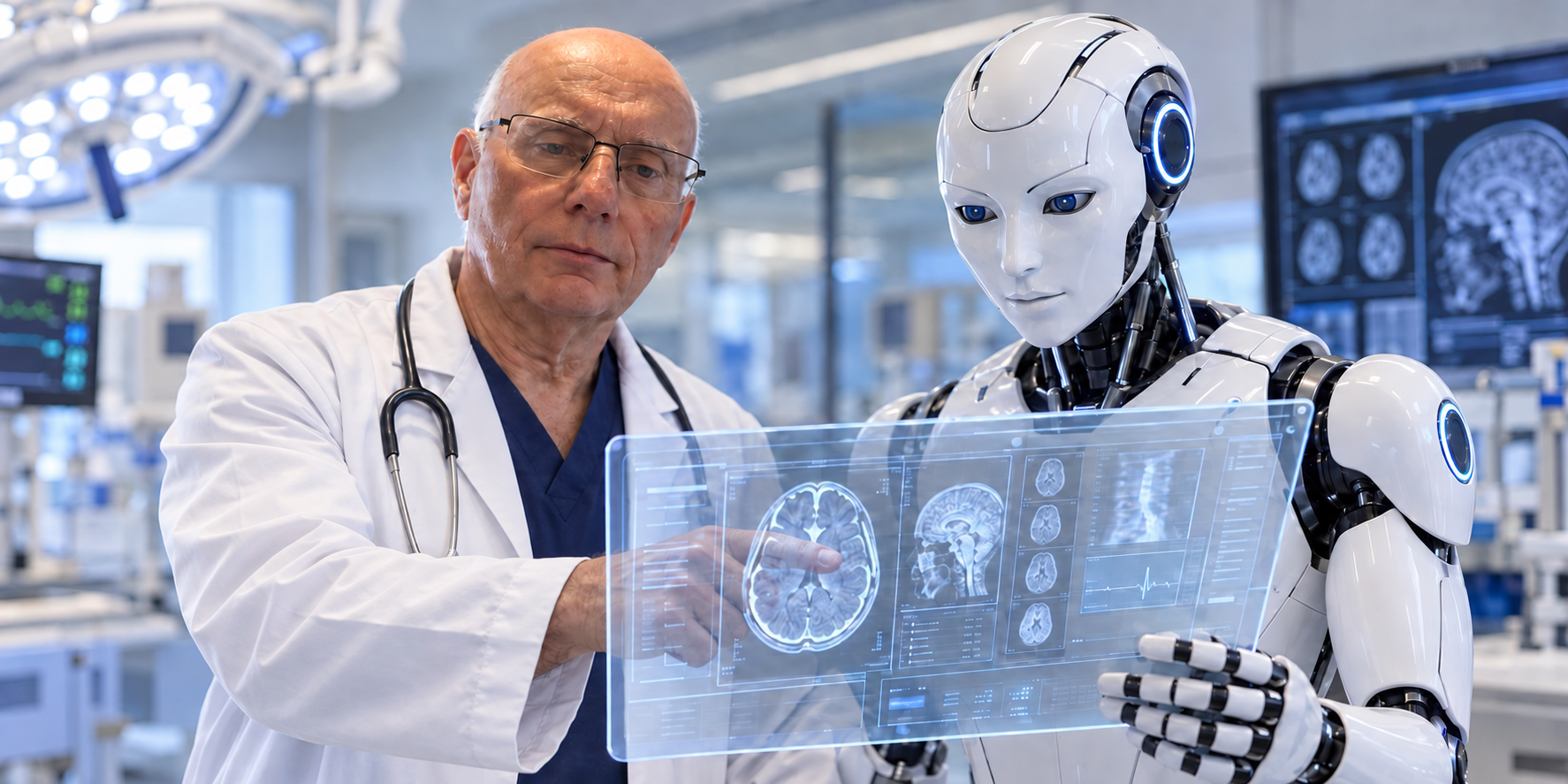
The current role of the PCP is rapidly being eroded by AI protocols. Some are subtle and the providers believe it helps them. And it does. But slowly (or not so much) the computers will learn and super-cede the provider. This is not way in the future, on the distant horizon. Rather, it is already here and will slowly and inorexably take over much of medicine and for some, to the betterment of our patients care. Yet this is still far from ideal. The one thing that can stop this is by having all of us wake up and do what we were trained to do. See, listen, ask and examine. This we can do and which the computer cannot (at least not yet).

Computers are capable of analyzing data, searching lab tests, and processing vast amounts of information to answer questions and interpret lab values as well as, if not better than, any provider, as they have access to the entire history of medical data. However, they lack the ability to physically examine a patient, which is an essential part of medical care. If examinations are neglected, it means that visits can easily be handled by microchips. Although many are very reluctant to think this is the future. They are correct, it is not the future; it is already here. But if used correctly and in conjuction with proper examinations, it will lead to a far improved medicine. If providers continue to triage and not treat, they will indeed see their  jobs jepordized. This is a choice, our choice. I believe it is the fundamental duty of a provider to thoroughly examine patients and use those findings, along with all other information to make an accurate diagnosis. Only direct interaction allows a physician to assess to subtle nuances, the non-verbal responses and truly understand the psychological state of their patient. Unfortunately, this is rarely practiced. We must all do better before it is too late.

Medicine and Surgery

Surgery has always been a combination of art and science. It is the science behind what to do and the art of how to do it. Well it is this and more. During the first couple of years in medical school we learn the science. It all begins in the anatomical dissection room where we walk in, proud medical students, and suddenly come face to face with 40 dead bodies in one room. It is our rite of passage. We have previously been split up alphabetically into groups of four and with our three dissecting colleagues we will over the course of a year learn the intricacies of anatomy together. We also sit through hours, attempting to understand and digest human Physiology, then face the slightly easier (at least for me) Histology. It is through these disciplines of Anatomy, Histology and Physiology and their varied interconnections that we are educated about normal human function. Then with the addition of Pathology and Microbiology we learn how it all can become abnormal as we study disease.

Generally speaking, when we put together all of the findings the anatomical findings along with their pathological equivalence and we come up with the disease entity this is the science. Only one we. Have learnt the normal and then the abnormal can we begin to learn what we think of as Medicine: the treatment of such diseases.

Nearly all surgeons will attest that Anatomy forms an absolutely foundational basis to enable us to diagnose and treat any disorder. It is therefore the most important course that any student of medicine will undertake and the one whose educational lapses can have the most profound implication for our patients.  

   No matter what procedures surgeons perform, major or minor, there are always quantifiable risks involved. We learn to manage, control, and lessen those risks wherever possible in order to achieve the best possible outcome.

   Just when we (erroneously) think we are masters of our craft, we are often humbled, by the simplest and most routine of procedures. As such, we must always maintain a healthy respect for the diseases that we are treating and not underestimate the likelihood of unexpected complications. Curve balls, although rare, are always expected. What we never know is when they will come at us. Rather than disease, complacency and arrogance are our real adversaries, or to put it more succinctly:

“Cockiness kills.”

The Dunning – Kruger Effect

The less you know, the more certain you feel. The more you learn, the more you realize how much you don’t know.

Ignorance breeds confidence. Mastery breeds humility.

Nowhere is this more dangerously apt than with surgeons.

  Thirty or so years on, walking into one of my exam rooms, I was met by a pleasant 78-year-old lady who was there to see me because of a recently diagnosed colon cancer. She explained that she was healthy except for the lump that had been found on a routine colonoscopy. Although I did not immediately recognize her or her name, perhaps in hindsight I should have. But we tend to remember only the patients we either see repeatedly or those who for some reason have left a mark on us, and then it’s usually not a good one. Difficult cases and bad outcomes tend to leave an indelible mark, whereas routine and even complex cases are rapidly forgotten. The patient acted with a familiarity that made me think I should know her. But I didn’t, at least not at first. She was accompanied by her grandson who also looked at me with a wide smile, friendly eyes, and sticking out his hand gave me a zealous, warm handshake, as if we were the best of friends. I still could not put two and two together. After going through perfunctory introductions, I finally just came right out and asked them if we had met before. Not terribly surprising from the way they were acting, they responded affirmatively, and the young man went on to say that I probably would not have remembered him because he was just a baby the last time we had crossed paths. To be more precise, he had been a newborn infant. Lifting up his shirt, he showed me a three-inch transverse scar on his upper abdomen. I immediately recognized the surgery that the scar represented but still did not remember him. However, I was sure that the last time we met he would have had neither the thick locks of reddish-brown hair nor his current deep husky voice. Once he told me his last name, it was as if someone had reached in deep band pulled out apparently long lost memories, as both his name and a vivid recollection of the events surrounding our previous encounter came flooding back. He was a patient who I would never have easily forgotten, not necessarily because the surgery was difficult but more because of everything that surrounded the plan to proceed with surgery.

    Over two and a half decades earlier, when I had been asked to see him, he was three weeks old, having been brought to the hospital by his very distraught parents. He had been vomiting constantly after bottle feeding and was unable to keep anything down. At that time, the mother explained, she had already had two girls, but he was her first boy. She recalled how, although he had acted desperately hungry every time she tried to feed him, he brought his formula back up with projectile force. This, she reminded me, was completely opposite to the way he had been for his first few weeks. Soon after his admission, an upper GI evaluation revealed the problem, as the oral contrast he ravenously swallowed would not exit his stomach. He had pyloric stenosis, a condition that involves a marked thickening of the muscle at the outlet of the stomach, which prevented it from emptying and he from obtaining necessary nutrition. Prior to surgical intervention with pyloro-myotomy (pioneered early in the last century) and routine intravenous fluid resuscitation, this was a grave disorder with a very high mortality, usually as a result of irreversible dehydration. When I first went to see him, it was clear that I had arrived at a significantly inopportune moment, as the nurses had been trying in vain, for some time, to try to get IV access. Surgery without correcting the always-present dehydration is always risky. The family had understandably become both very frustrated and apprehensive, which was certainly not helped by their screaming infant. This caused them to begin inquiring about transferring him to another hospital (Bigger isn’t always a better option.). When I had time to talk to them, I offered that if we were unsuccessful, that transfer was always a possibility, but certainly we had not exhausted all our options. The nurses, usually the experts at getting IVs in, had tried everything. He had multiple small pokes and bruises all over his scalp as testament to their tenacity, but still, all their attempts so far had failed. So, what were our choices? There was always interosseous access, where a needle is placed directly into the bone marrow and used for access. Although it sounds awful, it is a lot more comfortable than the incessant poking to try to get a regular IV in. Although it was not something we did routinely, it was still an alternative that we could call on if required. And now was that time. To be perfectly honest, although I knew about it, I had not personally put one in before, but I didn’t think this was the right time to convey this information to an already distraught family, closing in on their wits’ ends. Opening the package, I rapidly scanned the instructions. It was just as I remembered and seen others do. I knew this had to work. With the nurses holding the infant’s leg still, I carefully prepped the area then rapidly punctured the skin and the bone. I was pleasantly surprised by how easy it was to get the needle in, and within minutes we were giving him the fluid he desperately needed. After rehydrating him overnight, the next morning we took him to surgery, where he underwent both an uneventful and successful procedure to open the swollen muscle that was blocking the outlet of his stomach and allow it to empty. His stay in the hospital was brief, and the smiles across the face of his happy parents were priceless.

   It was not necessarily a very difficult or complicated surgery, but seeing the result 25 years later only consolidated why it was such a joy and privilege to be a physician and a surgeon. In a nutshell, it is always about solving problems, trying to keep patients healthy and families happy. However, not all surgeries have the desired outcome, sometimes because that outcome is not possible. This is, of course, the difficult part of surgical life.

True experts recognize the limits of what they know and what they do not. If they find themselves outside their circle of competence, they keep quiet or simply say ‘I don’t know’.

A good doctor tells you truthfully, I don’t know…………… A great doctor then adds; but I will find out.

Colonoscopy

Do I really have to drink all that stuff it tastes awful?

After you drink two gallons of anything you will usually no longer be a fan. Most importantly we need to keep in mind the goal of the exercise:   It is to check the colon for small polyps and then remove them. But you can’t remove what you can’t see!

Many patients really think they can cheat on their prep, when in the end they are only cheating themselves. None of us relish the prospect of evaluating a poorly prepared colon, but none more than the patient who could have a serious problem missed because it could not be seen. So, If you are going to bother to go through with it, why not just do it right?

Interestingly, over the years, despite advances in preparation options (again mainly for the benefit of the non-compliant) the colonoscopy ‘cleanses’ appear to be getting worse. Why? Are people are less inclined to follow instruction. This is certainly a possibility, especially in our contemporary age of painless easy entitlement perpetuated by unrealistic expectations that we (the medical profession) give our patients. But, I doubt that’s the only problem. Much more likely it is a combination of continuing deterioration of eating habits and an increasing number of our patients on boatloads of ‘colon slowing’ medications.

Many patients complain that they cannot drink the prep, as instructed, as it makes them feel sick. But there is no necessity for speed. The prep is not going anywhere (but your colon), which is why it works. So the answer is slow down, drink when you can, but get it in that night. Secondly, don’t forget (people don’t, but they pretend they do) the morning prep, as this is vital. It is amazing what our bowel produces overnight; and it is not clear!

The newer medical paradigm, to which we are all now a part, appears to do little for our patient. Current care takes longer and drives up healthcare costs in part to satisfy the increasing number of non-medical bureaucrats and their poorly conceived and constructed guidelines. Sure health care has improved (a bit), but it does not come cheaply and the small incremental improvements that have occurred come at a cost that is exponentially greater than the benefit. Such a cost to benefit growth rate cannot be sustained. Time and money are also slowly yet inexorably being shunted away from direct patient care to deal with the increasing burden of paperwork (computer-work) and cost of frequently unnecessary and exorbitantly expensive, testing. All of this adds tremendous cost under the false guise of care improvement.

Spending time cooped in an office creating a lengthy chart note, for billing purposes, instead of time at the bedside is the antithesis of good care and hopefully not why we went into medicine. It should never take longer to document what we do than to actually do it. 

In the end the solution it is up to each one of us. We must all be better gatekeepers (although I hate that word) of the medical dollar. Over the years we have allowed the decision of medical necessity to be relegated to the insurance companies and third party payers, with the very naïve expectation that they will know (let alone care) what is best for our patients. It is clear that what is best for the coffers of publicly traded insurance companies, is not necessarily aligned with the best interests of their customers, the patient.

So what is the best practice?

It is to trust our hands, our eyes, our ears and pause before ordering expensive tests that often add little if anything, except cost, to our patients’ care. It is our duty to educate our patients, and not succumb to uninformed (and now, media) pressure. Moreover we need to pass on this ability (to be a diagnostitian) to those apprehensively making their way in our footsteps.